
Blogs
Indica vs Sativa Vs Hybrid
Sep
Indica vs Sativa vs Hybrid: What’s the Difference?
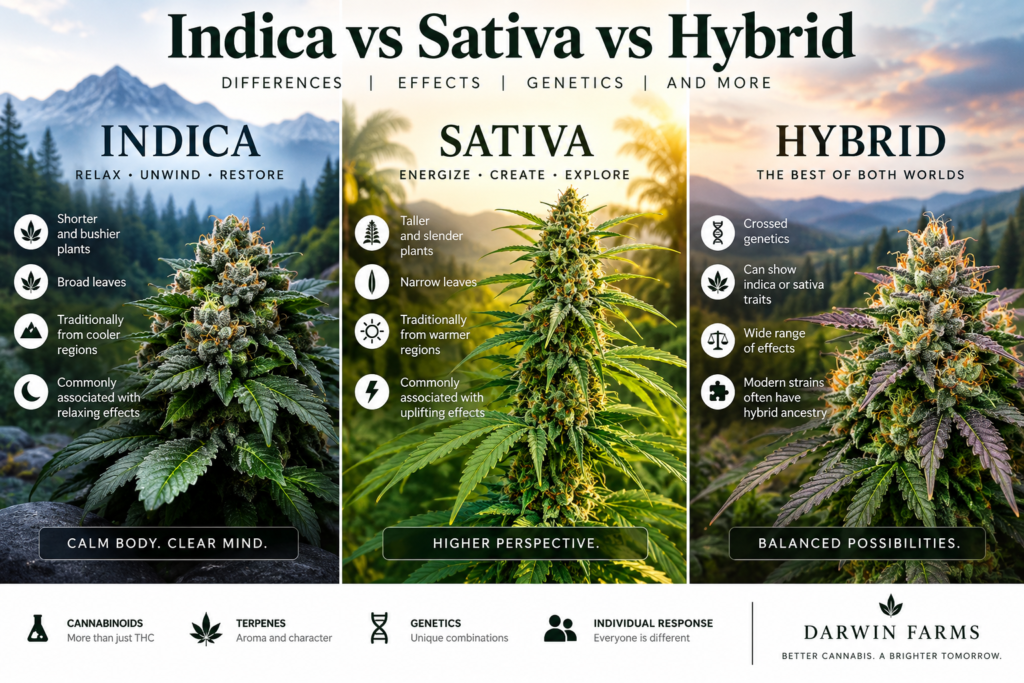
Indica vs Sativa vs Hybrid is one of the most common comparisons people make when learning about cannabis. The three terms appear on strain descriptions, cannabis menus, educational websites and product pages throughout the United States, the United Kingdom and other markets.
The traditional explanation is simple: indica strains are commonly associated with relaxing experiences, sativa strains with more uplifting or energetic experiences, and hybrid strains with characteristics from both. However, modern cannabis science shows that the difference between indica, sativa and hybrid is much more complicated than these familiar labels suggest.
This guide explains what the terms mean, where they originated, how modern hybrid genetics have changed cannabis classification, and why cannabinoids, terpenes and individual chemistry may tell you more about a strain than the words indica or sativa alone. You can also explore the wider Darwin Farms strain collection for examples of modern cannabis genetics.
Indica vs Sativa vs Hybrid: The Short Answer
If you simply want to understand the traditional difference between indica vs sativa vs hybrid, here is the basic comparison:
| Category | Traditional Description | Plant Characteristics | Common Consumer Association |
|---|---|---|---|
| Indica | Broad-leaf cannabis traditionally associated with Central and South Asian regions | Typically shorter and bushier with broader leaves | Relaxing, calming or body-focused experiences |
| Sativa | Narrow-leaf cannabis historically associated with warmer climates | Typically taller with narrower leaves | Uplifting, cerebral or energetic experiences |
| Hybrid | Cannabis produced by crossing different genetic lines | Can display characteristics from either parent lineage | Effects can vary widely depending on genetics and chemistry |
These descriptions are useful as a starting point, but they should not be treated as guaranteed predictions. Modern cannabis has been extensively crossbred, and two products carrying the same broad category can have very different cannabinoid and terpene profiles.
What Is an Indica Strain?
An indica strain is traditionally associated with Cannabis plants that grow shorter and more compact than classic sativa varieties. They are commonly described as having broader leaves, dense branching and relatively compact growth patterns.
The word indica historically referred more to botanical characteristics and geographic origin than to a specific type of psychoactive effect.
Over time, however, cannabis culture began using the word indica as shorthand for strains consumers often describe as relaxing, calming, heavy or suited to slower-paced situations.
Traditional Indica Characteristics
- Shorter and more compact plant structure
- Broad leaves
- Dense branching
- Frequently associated with shorter flowering periods
- Traditionally linked with mountainous or cooler growing regions
- Often marketed as producing relaxing or body-oriented experiences
The last point is important: an indica label does not guarantee sedation or relaxation. The actual experience can depend on THC concentration, other cannabinoids, terpene composition, dose, tolerance and individual response.
What Is a Sativa Strain?
A sativa strain traditionally refers to cannabis plants associated with taller growth, narrower leaves and longer flowering periods.
Classic sativa-type plants are historically associated with warmer or tropical regions where longer growing seasons can support taller plants.
In modern cannabis terminology, sativa has also become associated with consumer-reported experiences described as uplifting, cerebral, stimulating, creative or energetic.
Traditional Sativa Characteristics
- Taller plant structure
- Narrower leaves
- Longer internodal spacing
- Often associated with longer flowering cycles
- Historically connected with warmer climates
- Frequently marketed as uplifting or energizing
Again, the classification should be understood as a broad traditional label rather than a promise about how a particular cannabis product will affect every person.
What Is a Hybrid Cannabis Strain?
A hybrid cannabis strain is generally produced by crossing different cannabis genetic lines. Because cannabis breeders have been creating new crosses for generations, a large proportion of modern commercial strains have hybrid ancestry.
Some hybrids are described as:
- Indica-dominant hybrids
- Sativa-dominant hybrids
- Balanced hybrids
These terms can help describe how breeders or sellers interpret a strain’s ancestry, but they still do not provide a complete chemical profile.
For example, modern dessert-style strains, Gelato crosses and Runtz-related genetics often contain multiple generations of hybridisation. This is one reason the simple indica-versus-sativa distinction becomes less precise when discussing modern cannabis.
Indica vs Sativa vs Hybrid Comparison
| Feature | Indica | Sativa | Hybrid |
|---|---|---|---|
| Traditional plant shape | Short and bushy | Tall and slender | Varies by genetics |
| Leaf shape | Broad | Narrow | Can vary |
| Traditional effect association | Relaxing | Uplifting | Variable |
| Genetic background | Traditional indica ancestry | Traditional sativa ancestry | Crossed genetics |
| Modern reliability for predicting effects | Limited | Limited | Limited |
| Better information to examine | Cannabinoid profile, terpene profile, potency, dose and individual response | ||
Where Did the Terms Indica and Sativa Come From?
The words indica and sativa existed long before modern dispensaries or commercial strain menus.
Historically, botanists attempted to classify cannabis plants according to features such as morphology, geographical origin and intended use. Different classification systems have been proposed over time, and cannabis taxonomy remains more complicated than the modern consumer labels might suggest.
A peer-reviewed review of cannabis systematics explains that common commercial uses of the terms sativa and indica do not always align neatly with formal botanical taxonomy. Extensive breeding and genetic exchange have made simple classifications increasingly difficult.
For readers interested in the scientific history, see the peer-reviewed review Cannabis Systematics at the Levels of Family, Genus, and Species, available through the U.S. National Library of Medicine’s PubMed Central database.
Why Indica vs Sativa Is More Complicated Today
One of the biggest changes in modern cannabis is extensive hybridisation.
Breeders have crossed plants repeatedly to select characteristics such as aroma, flavour, cannabinoid production, appearance, resin production, growth traits and other desirable features.
As a result, many strains available today do not fit neatly into a traditional indica or sativa category.
This is particularly important when comparing indica vs sativa vs hybrid strains. A modern strain described as indica may contain genetics from several earlier hybrid lines. The same applies to strains marketed as sativa.
Do Indica and Sativa Labels Predict Effects?
Not reliably.
This is one of the most important points when learning the difference between indica and sativa.
A large study examining the phytochemical diversity of commercial cannabis in the United States found that the familiar Indica, Hybrid and Sativa labels did not reliably separate samples according to their chemical composition.
The research suggests that these broad commercial labels should not be treated as precise predictors of systematically different effects.
You can read the peer-reviewed research through PubMed Central: The phytochemical diversity of commercial Cannabis in the United States.
Does Indica Always Make You Relaxed?
No. Although indica strains are commonly marketed as relaxing, there is no universal rule stating that every indica-labelled strain will make every consumer feel relaxed or sleepy.
Individual experiences can vary because cannabis products differ in:
- THC concentration
- CBD concentration
- Minor cannabinoid content
- Terpene composition
- Serving amount or dose
- Consumption method
- Personal tolerance
- Individual physiology
This is why two strains both labelled indica can produce noticeably different reported experiences.
Does Sativa Always Make You Feel Energetic?
No. Sativa is traditionally associated with uplifting or energetic experiences, but that description is not guaranteed.
A high-THC sativa-labelled product could feel very different from a lower-potency product carrying the same category. Terpene composition and individual sensitivity can also influence the experience.
Rather than assuming that all sativas are energising, consumers should consider the complete product profile where reliable laboratory information is available.
Why Hybrid Cannabis Strains Are So Common
Hybrids dominate modern cannabis genetics because breeders continually combine established cultivars to create new characteristics.
A breeder may select parent plants for qualities such as:
- Aroma
- Flavour
- Resin production
- Flower structure
- Colour
- Potency
- Growth characteristics
- Terpene expression
Modern strains can therefore contain ancestry from numerous previous crosses.
You can see examples of this genetic diversity in the Darwin Farms strains directory, which includes Gelato-family genetics, Runtz-style strains and other contemporary hybrids.
Cannabinoids Matter More Than the Category Alone
Cannabinoids are naturally occurring compounds found in cannabis. THC and CBD are the best-known examples, although the plant contains many additional compounds.
THC
Delta-9-tetrahydrocannabinol, usually abbreviated as THC, is the primary intoxicating cannabinoid associated with cannabis.
Products with significantly different THC concentrations can create very different experiences even when both carry the same indica, sativa or hybrid label.
CBD
Cannabidiol, or CBD, is another major cannabis cannabinoid. Unlike THC, CBD is not generally regarded as intoxicating in the same way.
The relationship between THC, CBD and other compounds makes cannabinoid information more useful than relying exclusively on a broad strain category.
What Role Do Terpenes Play?
Terpenes are aromatic compounds found throughout the plant kingdom. They contribute to the distinctive scents associated with cannabis varieties, including citrus, pine, floral, spicy, earthy, fuel-like and dessert-style aromas.
Common cannabis terpenes include:
- Myrcene
- Limonene
- Caryophyllene
- Pinene
- Linalool
- Humulene
- Terpinolene
Terpenes are useful when describing the chemical and aromatic differences between cannabis varieties. However, consumers should be careful with claims that a particular terpene guarantees a particular psychological or medical effect. Research into the interactions between cannabis compounds remains active.
Indica vs Sativa Appearance
The traditional botanical differences between indica-type and sativa-type plants are often easier to describe than differences in their effects.
Traditional Indica Appearance
Indica-type plants are generally described as shorter and stockier, with broader leaves and compact branching.
Traditional Sativa Appearance
Sativa-type plants are usually described as taller and more slender, with narrower leaves and greater spacing between branches.
Hybrid Appearance
Hybrid plants may display a mixture of characteristics depending on their parents and breeding history.
However, growing conditions, phenotype selection and breeding can all influence appearance, meaning plant shape alone cannot provide a complete picture of a strain’s chemical composition.
Indica vs Sativa Genetics
Genetics provide useful information about how modern cannabis strains were developed.
A strain’s lineage can reveal its parent cultivars and help explain why related varieties may share certain aromas, colours or growth characteristics.
For example, Gelato 41 is associated with the Gelato family and a lineage commonly linked with Sunset Sherbet and Thin Mint Cookies genetics.
Other modern varieties such as Lemon Cherry Gelato demonstrate how contemporary cannabis names increasingly reflect complex hybrid families rather than simple pure-indica or pure-sativa categories.
What Does Indica-Dominant Hybrid Mean?
An indica-dominant hybrid generally means that a strain is considered a hybrid but is described as displaying more characteristics traditionally associated with indica ancestry.
This does not necessarily mean that a specific percentage of the plant can be scientifically measured as indica.
Terms such as “70% indica” or “60% sativa” are often breeder or marketing descriptions rather than precise laboratory measurements of a plant’s effects.
What Does Sativa-Dominant Hybrid Mean?
A sativa-dominant hybrid is generally a hybrid strain described as leaning toward characteristics traditionally associated with sativa ancestry.
Again, the label is better understood as a broad description of breeding history or intended positioning than as a guaranteed prediction of effects.
What Is a Balanced Hybrid?
A balanced hybrid is usually marketed as a strain that combines characteristics associated with both indica and sativa ancestry without being presented as strongly dominant in either direction.
Because almost every hybrid has its own cannabinoid and terpene composition, “balanced hybrid” should not automatically be interpreted as meaning perfectly balanced effects.
Indica vs Sativa vs Hybrid Effects
The traditional comparison normally looks like this:
- Indica effects: commonly described as relaxing, calming or body-focused.
- Sativa effects: commonly described as uplifting, cerebral or energetic.
- Hybrid effects: commonly described as combining characteristics associated with both.
These are consumer and industry associations, not guarantees.
Modern evidence increasingly supports looking at a cannabis product’s actual chemistry rather than assuming its broad category predicts exactly how someone will respond.
Indica vs Sativa THC Levels
Another common misconception is that either indica or sativa automatically contains more THC.
There is no simple rule.
High-THC strains can exist across indica, sativa and hybrid categories, while lower-THC varieties can also appear within each group.
When potency matters, the measured cannabinoid information for a specific batch is more informative than the strain category alone.
Is Hybrid Stronger Than Indica or Sativa?
Not necessarily.
The word hybrid describes genetic ancestry, not potency.
A hybrid strain can have high, moderate or relatively low THC depending on genetics, cultivation and the specific phenotype. Likewise, indica- or sativa-labelled products can vary considerably in potency.
How Should You Compare Cannabis Strains?
Instead of relying only on the words indica, sativa or hybrid, a more informative comparison can include:
- Cannabinoid profile: Consider THC, CBD and other available cannabinoid information.
- Terpene profile: Look at which aromatic compounds are dominant when laboratory data is available.
- Genetics: Research parent strains and breeding history.
- Aroma and flavour: Compare citrus, fruit, floral, earthy, creamy, spicy, fuel-like or other sensory characteristics.
- Potency: Compare measured potency rather than assuming strain type determines strength.
- Your previous experience: Individual responses to cannabis vary.
Indica vs Sativa vs Hybrid: Which Is Better?
There is no universally better category.
The best choice depends on what information a person is trying to understand about a strain and how that individual responds to cannabis.
Someone interested in genetics may focus on parent strains. Someone interested in aroma may pay closer attention to terpenes. Someone concerned with potency may focus primarily on cannabinoid testing.
This is why choosing solely between indica vs sativa vs hybrid can oversimplify the decision.
Modern Cannabis Is Better Understood as Chemistry + Genetics
A more complete way to understand cannabis is to combine several pieces of information:
Genetics + cannabinoids + terpenes + potency + individual response.
This approach gives far more context than the traditional three-label system alone.
It also helps explain why two products labelled “hybrid” can smell completely different or why two strains labelled “indica” may not produce identical reported experiences.
Examples of Modern Hybrid Cannabis Genetics
Many contemporary cannabis strains illustrate just how extensive modern hybridisation has become.
Examples within the Darwin Farms cannabis strain collection include:
Rather than assuming every strain fits perfectly into one traditional category, examining these individual strain pages can help readers understand differences in lineage, aroma, flavour and overall identity.
Indica vs Sativa vs Hybrid in the USA
In the United States, cannabis regulations vary substantially between jurisdictions, and state cannabis laws can differ from federal law.
That means a product being permitted under a particular state framework does not automatically mean identical rules apply across the country.
Consumers should always check the laws that apply in their own jurisdiction rather than relying on general cannabis information online.
Indica vs Sativa vs Hybrid in the UK
In the United Kingdom, cannabis is controlled under national drug legislation. Recreational possession and supply are not generally legal simply because a product is described as indica, sativa or hybrid.
There are separate legal frameworks for certain licensed activities and prescribed cannabis-based medicines.
Readers in the UK can consult current UK Home Office guidance on cannabis and cannabinoids for official information.
Common Myths About Indica, Sativa and Hybrid Cannabis
Myth 1: Indica Always Makes You Sleepy
Indica is traditionally associated with relaxation, but the label alone cannot guarantee a particular response.
Myth 2: Sativa Always Gives You Energy
Sativa is traditionally associated with uplifting experiences, but individual response and product chemistry can vary significantly.
Myth 3: Hybrid Means Exactly 50% Indica and 50% Sativa
No. Hybrid simply indicates crossed genetics. A hybrid does not automatically represent a perfect 50/50 division.
Myth 4: Sativa Always Contains More THC
THC concentration varies by cultivar, phenotype and batch. Category alone cannot determine potency.
Myth 5: Strain Names Guarantee Identical Products
Products carrying the same strain name can still vary because of genetics, phenotype selection, cultivation conditions and chemical composition.
What Should You Look for on a Cannabis Product Label?
Where regulated laboratory information is available, useful details may include:
- Total THC
- Total CBD
- Other measured cannabinoids
- Dominant terpenes
- Batch or lot information
- Testing information
- Producer or cultivator information
These details can provide more specific information than simply seeing the word indica, sativa or hybrid.
Explore Different Cannabis Strain Types
If you are researching modern cannabis genetics, the Darwin Farms strain guide provides a central directory for comparing different strain families and flavour profiles.
The goal should be to understand each strain individually rather than assuming every strain in one broad category will be identical.
Frequently Asked Questions About Indica vs Sativa vs Hybrid
What is the main difference between indica, sativa and hybrid?
Traditionally, indica refers to shorter, broader-leaf plants, while sativa refers to taller, narrow-leaf plants. Hybrid strains are crosses containing mixed ancestry. In modern commercial cannabis, these labels are widely used but do not reliably predict a product’s exact chemistry or individual effects.
Is indica stronger than sativa?
No. Indica is not automatically stronger than sativa. Potency depends on the cannabinoid concentration of the specific product or batch.
Is sativa stronger than indica?
Not necessarily. Both categories can include high-THC and lower-THC strains.
What is a hybrid strain?
A hybrid strain is cannabis bred from different genetic lines. Hybrids may be described as indica-dominant, sativa-dominant or balanced, although these descriptions are broad rather than precise chemical measurements.
Are most cannabis strains hybrids?
Many modern commercial strains have extensive hybrid ancestry because breeders have crossed cannabis varieties for generations to select desirable characteristics.
Does indica mean relaxing?
Indica is commonly associated with relaxing experiences, but the label does not guarantee that every person will experience relaxation from every indica-labelled product.
Does sativa mean energising?
Sativa is commonly associated with uplifting or energising experiences, but those effects are not guaranteed. Cannabis responses vary according to chemistry, potency, dose and individual factors.
What is an indica-dominant hybrid?
An indica-dominant hybrid is a crossed strain that breeders or sellers describe as leaning toward characteristics traditionally associated with indica genetics.
What is a sativa-dominant hybrid?
A sativa-dominant hybrid is a hybrid described as displaying more characteristics traditionally associated with sativa ancestry.
Is hybrid better than indica or sativa?
No category is inherently better. Each strain has its own genetics, cannabinoid profile, terpene profile and potency.
Do terpenes matter more than indica or sativa?
Terpenes provide useful information about a strain’s aroma and chemical profile, while modern research suggests commercial indica/sativa labels do not consistently map onto distinct chemical groups. However, effects are complex and should not be predicted from any single terpene alone.
How can you tell whether cannabis is indica or sativa?
Traditional plant morphology can provide clues, but modern hybridisation makes classification less straightforward. Commercial labels generally reflect breeding history or market classification rather than a simple laboratory test.
What is the difference between indica, sativa and hybrid effects?
The traditional model describes indica as relaxing, sativa as uplifting and hybrid as somewhere between the two. Scientific evidence indicates that actual cannabis experiences are more complex and depend on product chemistry and individual response.
Key Takeaways: Indica vs Sativa vs Hybrid
- Indica, sativa and hybrid remain widely used cannabis categories.
- The terms originally relate more closely to botanical history and plant characteristics than guaranteed effects.
- Indica is traditionally associated with shorter, broader-leaf plants.
- Sativa is traditionally associated with taller, narrow-leaf plants.
- Hybrid strains contain crossed genetics.
- Most modern cannabis has experienced substantial hybridisation.
- Indica does not automatically mean sedating.
- Sativa does not automatically mean energising.
- Hybrid does not automatically mean a 50/50 balance.
- Cannabinoid and terpene profiles provide additional information about a cannabis product.
- Potency should be judged using measured cannabinoid information rather than the strain category alone.
- Individual responses to cannabis can vary considerably.
Final Thoughts on Indica vs Sativa vs Hybrid
The traditional Indica vs Sativa vs Hybrid system remains useful as an introduction to cannabis terminology, but modern cannabis cannot always be understood through three labels alone.
Years of breeding and hybridisation have created complex genetics, while scientific research shows that commercial indica and sativa labels do not consistently correspond to clearly distinct chemical groups.
A better approach is to consider genetics, cannabinoid concentration, terpene composition, potency and individual response together.
For more educational information about contemporary cannabis genetics, explore the Darwin Farms Strains Guide or browse the cannabis strain collection.
Disclaimer: This article is provided for general educational purposes only. It does not constitute medical or legal advice. Cannabis laws differ between countries, U.S. states and other jurisdictions. Always follow the laws applicable where you live and consult an appropriate professional for individual medical or legal guidance.
